
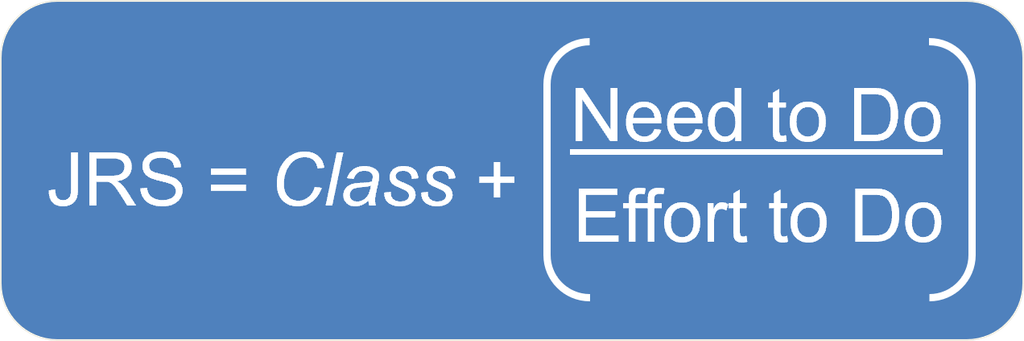
The Classification-Aware Job Ranking (CAJR or CAgeR) Model is a model developed for prioritizing jobs using a Job Ranking Score (JRS) determined by a Classification tier and then applying an offset within that tier that is calculated by dividing the Need to Do by the Effort to Do.
The Classification-Aware Job Ranking (CAJR) Model may be used to prioritize work/jobs that have an inherent tiering of priority levels. Such as:
- Feature implementation for tiered customer levels like Diamond, Gold, and Bronze customers
- Responses to customer requests for API enhancements when you have tiered support levels
- Initiatives for Enterprise, Mid-Market, Small and Medium Business (SMB) (revenue levels)
- Market tiers such as local, regional, national, and international (geographic tiers)
The Job Ranking Score is calculated by adding the ‘implementation need’ divided by the ‘effort to implement’ to a classification bias.
The need to implement considers the Reach, Impact, and Pressure. The more people to benefit from the job, the greater the value of the job, and the urgency of delivering the job are used to determine the ‘need to resolve’.
- The need to implement is captured as ((R + I) x C + P), where C is your confidence in knowing your customers and how they use the system when you select the R and I options.
The effort to implement considers the knowledge that those who will be working to implement the job have for the desired outcome. If the team has a low level of knowledge about the implementation domain or the code base, then the effort to implement will typically be larger than when a team has a high level of knowledge about the implementation domain or the code base.
How the need for the CAJR Model was identified
Weighted Shortest Job First (WSJF), as popularized by SAFe, is often used to prioritize work for the best economic outcomes. For most jobs you can consider business value, risk reduction, or opportunity enablement along with time critically to prioritize one job against another.
However, as you have a variety of work types or job classes, there may be valid reasons for a job with a lower cost of delay and longer duration needed for implementation to be prioritized over other jobs with a higher cost of delay and shorter implementation durations.
The Classification-Aware Job Ranking (CAJR or CAgeR) Model helps in this overlapping priority area while still supporting the intent of economic benefit.
Why use a model like CAJR when I can prioritize in other, simpler, ways?
“If everything is a priority, then nothing is a priority”
When you have multiple tiers, service levels, and other basic ranking systems that use High, Medium, and Low are insufficient when you have more than 3 jobs to consider!
How to Conquer the Tyranny of the Urgent | Psychology Today: In a world where everything feels important, and we constantly feel overwhelmed trying to stay on top of it all, it’s critical to ruthlessly prioritize tasks and obligations based on their true level of importance. This struggle is called the “Tyranny of the Urgent”
Being ruthless
Ruthless has a negative connotation, but you have to be able to say no to people, even yourself. That is good, because you can stop feeling overwhelmed and focus on your day knowing that you are making the most significant and appropriate contribution you can make during the day.
Using a job prioritization model that has sufficient fidelity, like CAJR, that considers typical prioritization factors enables you to objectively say no, or at least not yet, to those jobs with a lower calculated score. The calculation takes the subjectivity out of the conversation and the fidelity of the ranking values helps you avoid everything being ‘Priority 1’.
While recognizing tiers imply a priority we do have to consider balance for the jobs. Allowing one class or pure economics to dominate the ranking score is likely to lead to undesirable outcomes for the business.
The Classification-aware Job Ranking (CAJR) Model
For enterprises that consider multiple project or customer tiers,
Who are dissatisfied with their current prioritization approaches,
The Classification-aware Job Ranking (CAJR) Model,
Provides clarity on those parameters to be considered for an objective approach to determining a ranking score that is the basis for prioritization,
Unlike other ranking approaches that tend to be subjective and inadequate in capturing the various considerations where tiers are used.
For the CAJR Model, the project or customer classification (tier) is based on an overarching value to the enterprise. The CAJR Model uses this classification and consideration of Reach, Impact, Confidence, Pressure, and Understanding to calculate a Job Ranking Score.